









Vesicoureteral Reflux
One of the most important functions of the kidneys is to remove toxic substances from the blood and eliminate them through urine. After urine is produced by the kidneys, it is transported to the urinary bladder through tubes called ureters, where it is stored. At the junction between the ureters and the bladder, there is normally a valve-like mechanism that prevents urine from flowing backward toward the kidneys.
What is Vesicoureteral Reflux (VUR)?
One of the most important functions of the kidneys is to remove toxic substances from the blood and eliminate them through urine. After urine is produced by the kidneys, it is transported to the urinary bladder through tubes called ureters, where it is stored. At the junction between the ureters and the bladder, there is normally a valve-like mechanism that prevents urine from flowing backward toward the kidneys. During urination, the bladder contracts and the urethral sphincter (the ring-shaped muscle surrounding the urethra) relaxes, allowing urine to pass out through the urethra. From the kidneys to the urethral opening, the entire system is called the urinary tract.
Vesicoureteral reflux (VUR) refers to the backward flow of urine from the bladder toward the kidneys. In most children, reflux may occur due to a congenital abnormality caused by an abnormal connection between the ureter and bladder, resulting in a short and ineffective valve mechanism. In some children, abnormal urination patterns may also lead to reflux. Reflux predisposes children to urinary tract infections such as pyelonephritis (kidney infection), which may eventually result in kidney damage. More severe reflux may cause greater kidney damage and enlargement or deformity of the ureters and kidneys.
How Common Is VUR?
Reflux occurs in approximately 1–2% of healthy children. It is usually diagnosed after a child develops a urinary tract infection. The average age at diagnosis is 2–3 years, although it may be identified during infancy or later childhood. Three-quarters of treated children are girls.
In some cases, reflux may run in families. Approximately one-third of siblings of children with reflux may also have the condition. In addition, if the mother received treatment for reflux during childhood, reflux may also be seen in up to half of her children. Therefore, if one of your children has reflux, it is recommended that siblings also be evaluated by a physician.
Symptoms
Urinary tract infections are generally caused by bacteria and may affect the kidneys, bladder, or both.
If the kidneys are involved, the condition is called pyelonephritis. Typical symptoms include:
- Fever
- Abdominal or flank pain
- Chills
- Nausea or vomiting
If the infection primarily affects the bladder, it is called cystitis. Typical symptoms include:
- Painful urination
- Frequent urination
- Urgent urination
- Bedwetting
Newborns may not show these typical symptoms. Instead, they may experience:
- Fever
- Irritability
- Vomiting
- Diarrhea
- Poor appetite
- Delayed weight gain
The bacteria causing urinary tract infections are usually found in the child’s own stool. Despite careful cleaning, bacteria may settle in the genital area and eventually enter the bladder and urethra. If the child has reflux, bacteria can reach the kidneys and cause kidney infection.
Diagnosis
Voiding Cystourethrography (VCUG)
VUR is diagnosed using a test called voiding cystourethrography (VCUG). During this test, a thin and soft tube called a catheter is inserted into the urethra. A contrast liquid that becomes visible on X-rays is used to fill the bladder. The child is then asked to urinate while X-ray images are taken to determine whether urine flows backward toward the kidneys.
The test usually takes 15–20 minutes. Because catheter placement may occasionally cause infection, antibiotics may be recommended before and after the test. Parents may discuss ways to reduce discomfort related to catheter placement with their physician. Mild sedation may sometimes be given before the test. General anesthesia is not recommended because observing urination during the procedure is important.
Intravenous Pyelography (IVP)
Ultrasound, renal scintigraphy, or intravenous pyelography (IVP) may be required to determine whether reflux and urinary infections have damaged the kidneys. Except for ultrasound, these tests involve small amounts of radiation, although the exposure is relatively low compared with many other imaging studies. Children may feel discomfort during testing, and parents should discuss this with their doctor if needed.
Ultrasound (USG)
Ultrasound is frequently used for follow-up because it does not involve radiation exposure.
Urine Culture
Urinalysis and urine culture are used to diagnose urinary tract infections. The only possible risk during these tests is a reaction to the cleansing materials used before collecting the urine sample.
Urodynamics and Uroflowmetry (Voiding Tests)
Additional tests may be performed in children who cannot control urination during the daytime. These include:
- Uroflowmetry: the child urinates into a special toilet while urine flow speed and pattern are measured
- Post-void residual urine measurement: determines the amount of urine left in the bladder after urination
- Urodynamic testing: a small catheter is inserted into the bladder, which is then filled with sterile fluid while bladder size and pressure are measured
Grading of Vesicoureteral Reflux
Reflux can be measured and graded based on imaging findings showing how far urine flows backward and what changes occur in the urinary tract.
Grade I
Contrast reaches only the distal ureter during urination. This grade accounts for approximately 8% of VUR cases.
Grade II
Contrast reaches the renal calyces without causing dilation of the urinary tract. Approximately 37% of cases are in this stage.
Grade III
There is moderate dilation of the ureter, renal pelvis, and calyces, but the renal calyces are not yet blunted. About 25–37% of cases fall into this category.
Grade IV
There is dilation of the ureter, renal pelvis, and calyces with blunting of the calyces. Approximately 14–24% of cases are in this group.
Grade V
Severe hydroureteronephrosis and a tortuous ureter are present on the affected side. Approximately 5% of cases are classified as Grade V.
Complications and Damage Caused by VUR
Kidney Damage
Children with reflux and urinary tract infections may develop kidney scarring. The risk of kidney damage is higher in high-grade reflux. Reflux without infection generally does not cause kidney damage. Kidney scarring may lead to high blood pressure. If both kidneys are severely affected, kidney function may deteriorate and kidney failure may develop.
Urinary Tract Infection
Kidney infections (pyelonephritis) are more common in children with reflux than in children without reflux. Some children may require hospitalization for severe infections. Severe infections carry a higher risk of kidney damage.
Pregnancy Complications
Women who developed significant kidney damage due to urinary tract infections may experience complications during pregnancy, including:
- Premature birth
- Growth restriction in the baby
- Pregnancy loss
- Worsening kidney function in the mother
Treatment
The goal of treatment in children with reflux is to prevent kidney infection, kidney damage, and related complications. There are three treatment options: medical treatment, surgical treatment, and observation.
1. Medical Treatment
Medical treatment is based on the expectation that reflux may resolve spontaneously over time, usually within 5–6 years. The purpose is to protect the child from kidney damage and urinary tract infections.
In many children, reflux improves as the connection between the bladder and ureter matures. Lower grades of reflux resolve more easily. Unilateral reflux is more likely to improve than bilateral reflux.
Medical treatment includes:
- Antibiotic prophylaxis
- Bladder training
- Other supportive therapies
Children should undergo periodic examinations, urinalysis, and imaging studies.
Antibiotic Prophylaxis
Low-dose antibiotics taken every night before bedtime may help prevent urinary tract infections. Usually one-quarter to one-third of the standard dose is used. Long-term prophylaxis does not correct reflux but reduces the risk of infection. Reflux without infection generally does not damage the kidneys. Antibiotics are continued until reflux resolves or the risk decreases.
Bladder Training
Bladder training regulates urination intervals and teaches children and parents techniques to improve bladder function. The goal is to prevent urinary tract infections by establishing healthy voiding habits. Physicians may also educate families regarding genital hygiene and prevention of constipation.
Other Treatments
Anticholinergic medications may also be used. These medications are effective for improving bladder function and can generally be used safely for many years.
2. Surgical Treatment
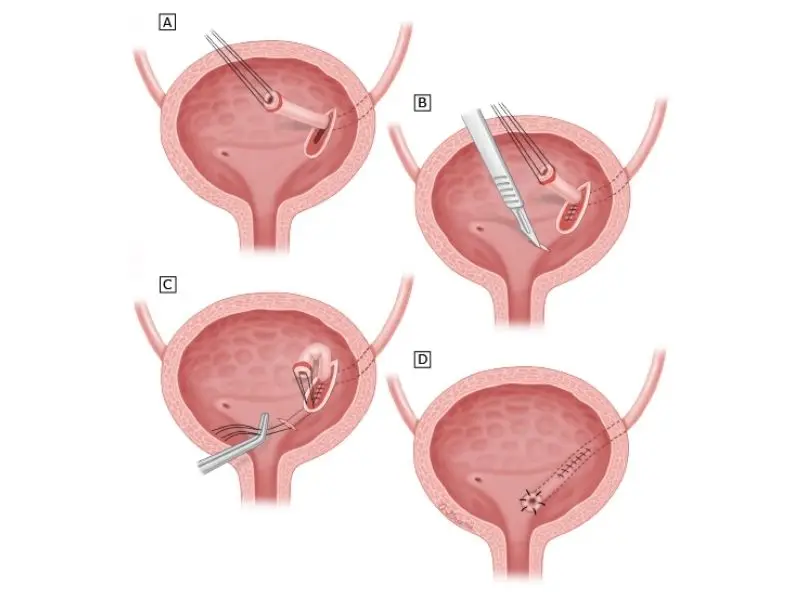
The goal of surgery is to correct reflux and protect the child from potential complications. Surgery is performed under general anesthesia through a lower abdominal incision. The valve mechanism between the bladder and ureter is reconstructed to prevent backward flow of urine. No artificial materials are required.
Several effective surgical techniques exist. A catheter is usually left in the bladder for several days after surgery. Hospitalization generally lasts 2–5 days. Follow-up imaging is performed to evaluate surgical success. If reflux is corrected successfully, recurrence is uncommon and antibiotic prophylaxis can usually be stopped.
Minimally invasive laparoscopic and robot-assisted surgical techniques are increasingly used and have success rates above 95%.
Injection Therapy
Another surgical option is endoscopic injection therapy. Under general anesthesia, a cystoscope is inserted through the urethra and a substance is injected where the ureter enters the bladder to correct reflux. This method is less successful than standard surgery but may be repeated if necessary.
3. Observation
In this approach, antibiotics are only given if a urinary tract infection develops. The goal is to diagnose and treat infections quickly in order to prevent kidney damage. However, infections may progress rapidly, and delays in obtaining urine samples and starting treatment may increase the risk of kidney injury.
Additional Care for Children with Reflux
Children with reflux require regular follow-up to monitor for urinary tract infections. Urinalysis and urine cultures should be performed when illness occurs. Blood pressure should also be monitored, especially in children with kidney damage.
Imaging studies are used to determine whether reflux improves, remains stable, or worsens over time. Other tests described above may also be used during follow-up.
Risks and Benefits of Treatment
Benefits
The success of medical treatment depends on the child’s age and the grade of reflux. Lower-grade reflux resolves more easily. Antibiotic prophylaxis helps prevent infections and kidney damage. Bladder training combined with antibiotics improves outcomes in children with bladder dysfunction.
Standard surgery successfully corrects most cases, with the highest success rates in Grades I and II reflux and lower success rates in Grades III–V reflux. Overall success is approximately 85%.
Endoscopic treatment is most effective in moderate reflux and less successful in severe reflux. One advantage is that the procedure can be repeated. Long-term effectiveness and safety continue to be evaluated.
Risks
Urinary Tract Infection
Approximately one-third of children treated for reflux may continue to experience urinary tract infections regardless of treatment type. However, successful surgery significantly reduces the risk of kidney infection because bacteria can no longer easily reach the kidneys.
Children receiving medical treatment have a 2.5 times greater risk of kidney infection compared with children who undergo successful surgery.
Kidney Damage
Preventing new kidney scarring is the main goal of reflux treatment. Imaging studies can identify kidney damage. Short-term studies show that the risk of developing new scars is similar in medically and surgically treated children, approximately 15–20%.
Kidney scarring increases the risk of hypertension and, in severe cases, kidney failure requiring dialysis or kidney transplantation.
Medication-Related Problems
Minor side effects of antibiotics include:
- Skin rash
- Nausea
- Vomiting
- Abdominal pain
- Bad taste in the mouth
Skin rash is the most common side effect. Other side effects occur in fewer than 10% of children.
Anticholinergic medications may cause:
- Facial flushing
- Dry mouth
- Reduced sweating
- Increased heart rate
- Blurred vision
- Dizziness
- Constipation
Parents should discuss any side effects with their physician.
Surgical Complications
The most common complications after reflux surgery include:
- Persistent reflux
- Ureteral obstruction
- Reflux developing on the opposite side
The risk of persistent reflux after standard surgery is approximately 2–4%, although it may be slightly higher in Grade V reflux. Ureteral obstruction occurs in about 2% of cases and often requires correction.
In about 5% of cases, reflux may later develop in the opposite ureter. Most children experience postoperative pain, although modern pain-control methods are generally effective.
Some children may develop urinary tract infections after surgery, which are usually easily treated with antibiotics. Painful urination and temporary urinary control problems may occur but usually resolve within 1–2 weeks. Blood in the urine may persist for about one week. Blood transfusion is very rarely required.
Difficulty urinating has been reported in approximately 2–3% of cases and usually resolves spontaneously after a short period.
Hospital Stay
If a child develops a severe urinary tract infection, hospitalization for intravenous antibiotics and fluids may be required for 2–4 days.
Hospital stay after reflux surgery usually lasts 2–5 days depending on the surgical technique used. In recent years, both hospitalization and operation times have become significantly shorter.
Factors to Consider When Choosing Treatment
Several factors should be considered when selecting the best treatment option for a child, including:
- Severity of reflux
- Whether reflux affects one or both sides
- Child’s age and gender
- Presence of kidney damage
- Presence of bladder dysfunction such as urinary incontinence
- Family preference
Lower-grade reflux generally has a higher likelihood of spontaneous resolution and successful treatment. In severe reflux, the likelihood of spontaneous improvement is lower even with antibiotics.
Standard surgery is effective in approximately 96% of cases.
Scientific evidence suggests that most children with Grades I–III reflux improve over time with regular antibiotic prophylaxis. Therefore, antibiotic treatment is usually preferred initially in Grades I–IV because it carries lower short-term risks.
Children with severe reflux or infections despite prophylactic antibiotics are generally advised to undergo surgery because the risk of kidney damage is high.
Surgery is usually recommended for Grade V reflux because spontaneous resolution is unlikely.
Surgical treatment is more commonly recommended in girls because they have a higher risk of urinary tract infections.
Other factors such as overall health, ability to tolerate antibiotics, financial conditions, and social circumstances should also be considered.
Family opinion is important when deciding between medical and surgical treatment. Families should be fully informed about treatment costs, possible difficulties, follow-up schedules, and required tests.
The information here is for general education only and is not medical advice. Please consult your physician for personalized treatment.