









Hypogonadism
Low levels of testosterone, the male hormone, are known as hypogonadism. Other names for this problem include testosterone deficiency syndrome, hypergonadotropic hypogonadism, and hypogonadotropic hypogonadism. Testosterone deficiency means that the testes are not producing enough testosterone in men. Low testosterone, or hypogonadism, has many causes, and treatment is tailored to the underlying cause.
Hypogonadism: Low Testosterone Levels in Men
Low levels of testosterone, the male hormone, are known as hypogonadism. Other names for this problem include testosterone deficiency syndrome, hypergonadotropic hypogonadism, and hypogonadotropic hypogonadism. Testosterone deficiency means that the testes are not producing enough testosterone in men. Low testosterone, or hypogonadism, has many causes, and treatment is tailored to the underlying cause.
The main symptoms include decreased libido, erectile dysfunction, and fatigue. Symptoms vary depending on the patient's age and the severity of the testosterone deficiency. 98% of testosterone is secreted by Leydig cells in the testes. In adult men, testosterone levels decrease with age, approximately by 10% every 10 years. While low testosterone, or hypogonadism, affects about 2% of all men, it is known that more than 8% of men between the ages of 50 and 79 have low testosterone.
Normally, a blood testosterone level below 250-300 ng/dl is considered testosterone deficiency in men. However, rather than just the level, an assessment may need to consider the negative effects on the patient. In some cases, testosterone levels may be normal or even high, but due to receptor problems or other reasons, the testosterone may be ineffective. This would introduce a new calculation criterion such as the bioavailable testosterone ratio.
What is the function of testosterone in men?
Testosterone is the primary male hormone, meaning it is an androgen. It is the hormone that gives and develops masculine characteristics in men; what estrogen is to women, testosterone is to men. It is absolutely essential, especially for sexual function and sperm production (spermatogenesis).
In men, testosterone production generally includes the following:
- Development of sexual organs and genital organs
- Muscle mass formation and development in men.
- Production of red blood cells
- Maintaining and developing bone density.
- Well-being, feeling good, regulating one's daily mental mood.
- Preservation and development of sexual and reproductive functions.
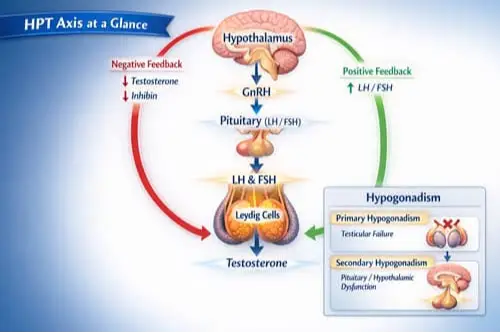
Testosterone, an essential hormone in men, is tightly controlled in the body. Testosterone production in the testes is regulated by the hypothalamus in the brain, which in turn stimulates the release of gonadotropin-releasing hormone (GNH), and the pituitary gland, also in the brain, which rhythmically releases LH (luteinizing hormone) and FSH (follicle-stimulating hormone) according to daily needs. LH and FSH stimulate testosterone production from Leydig cells in the testes, while also stimulating the adrenal gland to secrete some testosterone-like products such as DHEA (dehydroepiandrosterone), and controlling their levels. Sufficient testosterone secretion also exerts control over LH and FSH in the pituitary gland. Any problems in these areas negatively affect testosterone production. In other words, any problem related to the testes, hypothalamus, and/or pituitary gland can cause low testosterone (male hypogonadism).
Who is most affected by hypogonadism, or low testosterone?
Low testosterone in men, or hypogonadism, can affect men of all ages, from newborn to adult. In fact, if there is insufficient testosterone, the prostate and some other organs may not develop at all.
Low testosterone most commonly affects the following people:
- elderly
- Obese people, that is, those who are overweight
- Patients with uncontrolled type 2 diabetes
- Those with sleep apnea.
- Those with chronic diseases such as kidney dysfunction or liver cirrhosis
- Those with HIV/AIDS
What are the symptoms of hypogonadism, or low testosterone?
In adult men, low testosterone levels can indicate hypogonadism, with the following symptoms:
- Decrease in sexual desire, libido.
- Erectile dysfunction
- Hair loss and thinning in the armpits and genital areas.
- Testicular shrinkage
- Hot flashes, like those experienced by women going through menopause.
- Low or zero sperm count (azospermia) causes male infertility.
- A depressed mood, a low spirits.
- Memory problems such as concentration difficulties and forgetfulness.
- Increase in body fat percentage.
- Male breast tissue enlargement (gynecomastia)
- Decrease in muscle mass and strength.
- Decreased endurance in the body
Symptoms that may suggest low testosterone in children include:
- A slowdown in the child's height growth, with the arms and legs continuing to grow disproportionately to the rest of the body.
- Reduction in genital hair.
- Regression and reduction in penis and testicular growth.
- Decrease or cessation of voice deepening.
- Lower than normal power and durability.
What are the causes of hypogonadism, or low testosterone?
Hypogonadism, or low testosterone levels, has several possible causes.
- Primary testicular disorder/failure (Primary Testicular Failure), Congenital hypogonadism
- Secondary-acquired-secondary testosterone deficiency, hypogonadism (pituitary/hypothalamus dysfunction in the brain).
1. Primary testicular disorder/failure (Primary Testicular Failure)Congenital hypogonadism, or present-day hypogonadism, refers to a condition where the testes, despite sufficient stimulation, fail to produce enough testosterone. In other words, the problem is that the Leydig cells in the testes cannot produce sufficient testosterone. In these patients, luteinizing hormone (LH) and follicle-stimulating hormone (FSH) levels are very high in the pituitary gland. However, due to the problem in the testes, they cannot respond. As a result, the testes produce very little testosterone and sperm, or none at all. This condition is also known as hypergonadotropic hypogonadism.
Primary testicular dysfunction (Primary testicular insufficiency) and congenital hypogonadism have the following causes:
- Congenital absence of testes (anorchia)
- Undescended testicle (cryptorchidism).
- A deficiency or hypoplasia of Leydig cells, which produce testosterone in the testes.
- Chromosomal disorders, Klinefelter syndrome (a genetic condition in which males are born with an extra X chromosome: XXY instead of XY)
- Noonan syndrome (a rare genetic condition that can cause delayed puberty, undescended testicles, or infertility). Myotonic dystrophy (part of a group of inherited disorders called muscular dystrophies).
The following are acquired conditions that can affect your testicles and lead to primary testicular dysfunction:
- Injury or removal of the testicle(s)
- Testicular inflammation - Orchitis. This condition is usually the result of a bacterial infection, such as a sexually transmitted infection, but it can also be caused by viral infections like mumps.
- Chemotherapy or radiation therapy for testicular cancer or other cancers.
- The use of cortisone for various reasons.
2- Secondary-acquired-secondary testosterone deficiency, hypogonadism (pituitary/hypothalamus dysfunction in the brain):This refers to conditions in the brain—specifically the hypothalamus and/or pituitary gland—that affect how secondary hypogonadism develops. This condition is known as hypogonadotropic hypogonadism due to low levels of luteinizing hormone (LH) and follicle-stimulating hormone (FSH). These low levels, in turn, lead to decreased testosterone and sperm production.
Congenital causes of secondary hypogonadism include:
- Isolated hypogonadotropic hypogonadism (a condition causing low gonadotropin-releasing hormone levels from birth).
- Kallmann syndrome (a rare genetic condition that causes a loss of development of gonadotropin-releasing hormone-producing nerve cells in the hypothalamus. It can also cause a loss of sense of smell).
- Prader-Willi syndrome (a rare genetic multisystem disorder that can cause hypothalamic dysfunction).
The following acquired conditions can lead to secondary hypogonadism:
- Hypopituitarism - Pituitary insufficiency (This condition can result from a tumor affecting the pituitary gland, infiltrative disease, infection, injury, radiation therapy, or surgery.)
- Hyperprolactinemia - or prolactinoma
- Iron overload - iron storage disease (hemochromatosis)
- Brain or head trauma
- Cushing syndrome - Due to excessive ACTH secretion.
- Liver cirrhosis/failure
- Chronic kidney failure
- Diseases that weaken the immune system, such as HIV/AIDS.
- Alcohol dependence or alcoholism
- Uncontrolled diabetes.
- Obesity.
- Sleep apnea, Obstructive sleep apnea.
- Certain medications include estrogens, psychoactive drugs, metoclopramide, opioids, leuprolide, goserelin, triptorelin, and novel androgen biosynthesis inhibitors for prostate cancer.
- A type of secondary male hypogonadism that occurs as a result of normal aging. As men age, there is a deterioration in hypothalamic-pituitary function and Leydig cell function, which reduces testosterone and/or sperm production. Age-related low testosterone is more common in men with type 2 diabetes, overweight, and/or obesity.
How is hypogonadism, or low testosterone, diagnosed?
If symptoms of low testosterone are present, the first step is to obtain a detailed medical history, including medications used and smoking habits.
The following tests are used to diagnose low testosterone:
- Blood test for total testosterone: Two blood samples are taken between 9 and 10 a.m., the time when testosterone levels should be at their highest.
- Blood test to measure luteinizing hormone (LH): This test can help determine if low testosterone is caused by a problem with your pituitary gland.
- Blood test to measure prolactin levels: High prolactin levels can be a sign of pituitary gland problems or tumors.
Hypogonadism, How is Low Testosterone Treated?
In the treatment of low testosterone, testosterone replacement therapy is performed in several different ways:
Testosterone skin gels:The gel is applied daily to clean, dry skin. It is one of the most common treatment methods.
Intramuscular testosterone injections:Injections can be administered intramuscularly every 1-2 weeks or every 10 weeks. Subcutaneous preparations are also available.
Testosterone skin patches:These patches are applied to the skin daily.
Testosterone pellets:Testosterone-loaded pellets are implanted under the skin every three to six months. The pellets provide regular and long-lasting doses of testosterone.
Buccal (intrabular) testosterone preparations:These are adhesive preparations applied to the gums twice a day. Testosterone rapidly enters the bloodstream through the gums.
Testosterone nasal gel:Testosterone gel is applied by injecting it into each nostril three times a day.
Oral testosterone tablets:For people with low testosterone due to certain medical conditions such as Klinefelter syndrome or tumors damaging the pituitary gland, a testosterone pill called undecanoate is available on the market.
Testosterone therapy is not preferred in the following situations:
- Prostate cancer
- Breast cancer
- Uncontrolled heart failure
- Untreated obstructive sleep apnea
What are the side effects of testosterone therapy?
- Acne or oily skin on the face and other areas.
- Swelling in the ankles and legs.
- In men with prostate problems, there is an increase in urinary complaints and difficulty urinating.
- Breast enlargement or tenderness
- Increase in sleep apnea symptoms.
- Testicular shrinkage
- Irritation caused by testosterone medications applied to the skin.
Abnormalities in laboratory measurements that may occur with testosterone treatment include:
- Increased levels of prostate-specific antigen (PSA) in the blood.
- An increase in the number of red blood cells (erythrocytes).
- A decrease in sperm count can lead to infertility.
CONCLUSION
There is no one-time solution for low testosterone. However, regular hormone replacement therapy can help increase libido, alleviate symptoms of depression, and improve energy levels in individuals experiencing low testosterone. Treatment can also increase muscle mass and bone density. The mortality rate for men with testosterone deficiency is significantly higher than for men with normal testosterone levels.
Can low testosterone, or hypogonadism, be prevented?
Lifestyle habits that can help keep testosterone levels normal include:
- Eating healthy, natural, and organic food.
- Doing regular sports and exercise.
- Reaching and maintaining ideal weight
- Avoid smoking, alcohol, and drug use.
The information here is for general education only and is not medical advice. Please consult your physician for personalized treatment.