









Penile Curvature
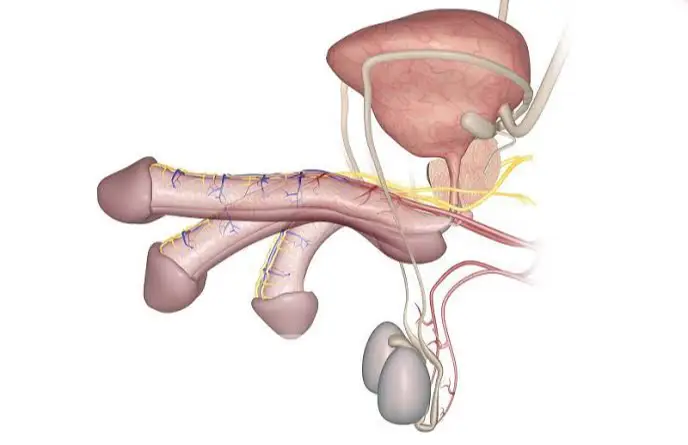
When erect, the penis should be straight, forming a 90-degree angle. Any deformation of the penis to the right, left, up, or down, outside of this right angle, is considered penile curvature. Penile curvatures can be congenital or can develop later in life due to certain illnesses, surgical procedures, or traumas.
What is penile curvature?
When erect, the penis should be straight, forming a 90-degree angle. Any deformation of the penis to the right, left, up, or down, outside of this right angle, is considered penile curvature. Penile curvatures can be congenital or can develop later in life due to certain illnesses, surgical procedures, or traumas.
Congenital penile curvature
The penis has two spongy tissues containing blood vessels that enable erection, and a third spongy tissue containing the urethra. During pregnancy, developmental delays in one of these spongy tissues can cause the penis to curve towards the less developed side during erection. Additionally, hypospadias, a condition where the urethral opening is located lower than it should be, can also cause penile curvature. In these patients, the spongy tissue containing the urethra is generally less developed, resulting in the penis curving downwards during erection.
Acquired penile curvature
Penile deformities in older adults are most commonly caused by Peyronie's disease. Peyronie's disease is a condition characterized by calcification between the spongy tissue of the penis, which contains blood vessels responsible for erection, and the outer sheath surrounding this tissue, which enables erection. Typically appearing after the age of 50, Peyronie's disease initially causes pain, followed by deformity over time. In addition, penile deformities and curvature can also result from surgical procedures on the penis.
Symptoms
In patients with hypospadias, also known as congenital penile curvature, pain or similar complaints are not observed. However, in patients with hypospadias, because the urethral opening is located on the underside of the penis, urine may come from this area instead of the normal location, and depending on the condition of the urethral opening, urinary symptoms such as difficulty urinating, frequent urination, residual urine, and burning during urination due to accompanying infections may occur. Penile curvature is usually observed at birth.
In patients with congenital penile curvature, the curvature is usually noticed when erections begin during puberty. In childhood, it can be detected during a careful examination.
In Peyronie's disease, which develops in old age, the first symptom is pain in the penis. Peyronie's disease occurs in two phases: "Acute" and "Chronic". The "Acute" phase is when plaques begin to form and pain, especially during erection, accompanies the disease. This phase, lasting twelve to eighteen months, is followed by the chronic phase, where deformity occurs. In both the acute and chronic phases, hard plaques are palpable on the penis. Depending on the location and extent of the plaque in the chronic phase, loss of erection may also occur.
Risk factors that cause penile curvature
Peyronie's disease is known to occur more frequently in diabetic patients. It is also more common in individuals with certain collagen or connective tissue disorders. Although rare, patients who have undergone prostate surgery may also develop Peyronie's disease later in life.
Can penile curvature prevent a man from having children?
In children born circumcised, the proximity of the urethral opening to the testicles can make ejaculation difficult, thus hindering the chances of having children. However, if the opening is close to the tip of the penis and the curvature does not interfere with sexual intercourse or ejaculation, there is no obstacle to having children in these patients. On the other hand, although rare, some patients may also experience additional problems such as undescended testicles. These cases need to be evaluated separately. In Peyronie's disease, if the person can achieve an erection and have sexual intercourse, there is no obstacle to having children. In patients with congenital penile curvature, if the degree of curvature is such that it makes sexual intercourse difficult, there may be problems with having children due to the difficulty in having sexual intercourse.
TREATMENT
Hypospadias
The treatment for hypospadias, also known as circumcision, is strictly surgical. It is important to perform surgical treatment in childhood, before reaching adulthood, after the penis has reached sufficient length. During the surgical procedure, the urethral opening is moved to the tip of the penis, and any curvature should be corrected.
Peyroni's disease
Peyronie's disease, the most common cause of penile curvature in older adults, has different treatment options depending on whether it's in the acute or chronic phase.
Treatment of acute Peyronie's disease:In the acute phase, since the plaques causing penile curvature have not yet fully formed, drug treatment is applied. In addition to medications that inhibit plaque development, methods such as shock therapy and injections of collagen synthesis inhibitors have also been used in recent years. If diagnosed early and treated effectively during this period, penile curvature can be self-limiting or even reversible. Therefore, making a diagnosis in the acute phase is extremely important. If pain is present, especially if a hardness or irregularity is felt on the penis, a doctor's evaluation is absolutely necessary.
Treatment of chronic relapsing Peyronie's disease:Once the chronic phase is reached, that is, when the painful period ends and deformity begins, drug treatments are not very effective. However, intralesion injections or shock therapy can be tried during this period. However, corrective surgical treatments are primarily applied in the chronic phase. The decision for surgical treatment is also made by evaluating whether spontaneous erection is present along with the deformity. In patients with erectile dysfunction, in addition to surgical treatment that corrects the deformity, penile prosthesis implantation, commonly known as a "happiness rod," is also necessary.
Which patients undergo surgery for penile curvature?
In cases of hypospadias and some Peyronie's disease, surgical treatment is absolutely necessary. Apart from these, surgical treatment is generally recommended for curvatures greater than 30 degrees that impair sexual intercourse. However, it should be remembered that penile curvatures can cause psychological distress. Therefore, each patient should be thoroughly evaluated, their expectations from treatment should be clearly understood, and appropriate treatment methods, results, and complications should be discussed with the patient before a decision is made.
How is surgical treatment performed for penile curvature?:
In suitable cases, simple plication techniques can be used to correct the curvature. In this method, the curvature is corrected by placing plication sutures on the penis on the opposite side of the curvature. In more complicated cases, correction is achieved by covering the plaque areas formed on the penis with graft materials obtained from leg veins, similar to those used in bypass surgeries. In cases where correction with graft materials is not possible or erection is not observed, penile prosthesis implantation is required.
How long do penile curvature surgeries take?
Surgical interventions for congenital penile curvature are generally simple procedures. The problem can be resolved with surgical treatments lasting between half an hour and one hour. However, the duration of surgical treatments involving grafting varies from person to person and depending on the severity of the condition. During these surgeries, care must be taken to protect the vascular and nerve structure of the penis, ensuring that penile stimulation and blood supply are not impaired. In a patient with an erection, damaging the vascular and nerve structure during surgery requiring grafting can lead to a risk of loss of erection. Hypospadias surgery can also vary depending on the location of the urethral opening. The closer the opening is to the tip, the easier the correction will be. During these procedures, especially in plication and graft surgery, the use of devices such as microscopes or loops that facilitate the visualization of the vascular and nerve structure and allow for the preservation of these tissues is preferred.
What should patients be aware of after penile curvature surgery?
The most significant problem after surgical treatment is the recurrence of the curvature. The main reason for this is the dehiscence of the sutures, especially in adult men, due to nocturnal erections. Therefore, several treatment alternatives aimed at suppressing nocturnal erections may be suggested in the post-operative period. For this purpose, sleeping pills or hormonal agents to suppress male hormones may be recommended. It is also extremely important to avoid sexual intercourse for 4 to 6 weeks after the surgery.
The information here is for general education only and is not medical advice. Please consult your physician for personalized treatment.