









Undescended Testicle
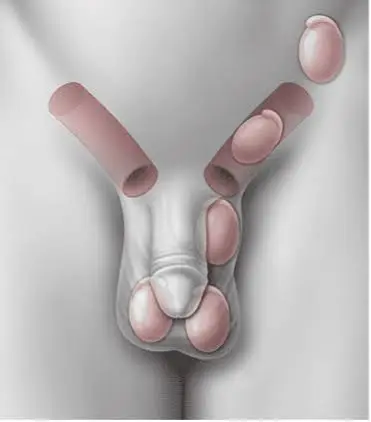
Failure of one or both testicles to descend into the scrotum (the skin pouch located beneath the penis) is called an undescended testicle, also known as “cryptorchidism,” “hidden testicle,” or “undescended testicles.” Although this condition is relatively uncommon, it is seen more frequently in premature babies. During fetal development, the testicles first form in the abdominal area near the kidneys.
What is an Undescended Testicle?
Failure of one or both testicles to descend into the scrotum (the skin pouch located beneath the penis) is called an undescended testicle, also known as “cryptorchidism,” “hidden testicle,” or “undescended testicles.” Although this condition is relatively uncommon, it is seen more frequently in premature babies. During fetal development, the testicles first form in the abdominal area near the kidneys. Around the seventh month of pregnancy, they begin descending toward the groin. By approximately 6 months after birth, they are expected to reach their final position within the scrotum. The main function of the testicles is the production of male hormones and sperm. An undescended testicle may still produce hormones, but its ability to produce sperm is significantly impaired. Approximately 1% of boys at one year of age are diagnosed with an undescended testicle. It is the most common congenital abnormality of the genital organs in newborn boys. Usually only one testicle is affected, but the likelihood of both testicles being undescended is approximately 10%.
Causes of Undescended Testicles
The exact reason why some testicles fail to descend is not fully understood.
Risk factors include:
- Family history of undescended testicles or associated genital abnormalities
- Premature birth or low birth weight
- Conditions affecting fetal growth during pregnancy
- Maternal smoking or alcohol consumption during pregnancy
- Long-term exposure to certain agricultural chemicals
Types of Undescended Testicles
Undescended testicles are divided into two groups based on physical examination: palpable (can be felt by hand) and non-palpable (cannot be felt). Approximately 70% of undescended testicles are palpable. A palpable undescended testicle may have stopped at any point along the normal pathway of descent. In some cases, the testicle may be located outside the normal pathway, known as an ectopic testicle. In certain patients, due to a strong cremasteric reflex, the testicle may move back and forth between the scrotum and abdomen; this is called a retractile testicle. A non-palpable undescended testicle is generally located somewhere within the abdomen. It may be found above the groin ring, near the kidneys, between the rectum and bladder, or close to the abdominal wall. Treatment is determined according to the location and presence of the testicle.
Ectopic palpable testicles require surgery. Retractile testicles that can be manually brought down may be monitored closely until puberty. If both testicles are non-palpable and sexual differentiation appears normal, endocrine and genetic evaluations should be performed. Patients and parents usually seek medical attention because the testicles cannot be felt in the scrotum. The absence of a testicle is typically noticed during the newborn examination immediately after birth. During the first 6 months, undescended testicles should be monitored regularly. If the testicle does not descend spontaneously, treatment becomes necessary.
Diagnosis
Physical Examination
During physical examination, undescended testicles are classified as palpable or non-palpable. Imaging methods are generally not very helpful in this regard. For examination, the child is placed on their back with the legs positioned like a frog. If one testicle is non-palpable and the other is larger than normal, the absent testicle may be undeveloped or atrophic (small). The abdomen should also be visually examined to ensure the undescended testicle is not ectopic.
Diagnostic Laparoscopy
Laparoscopic intra-abdominal evaluation is the only reliable way to diagnose a non-palpable undescended testicle. Examination under general anesthesia is recommended because some previously non-palpable testicles may become palpable after muscle relaxation under anesthesia.
TREATMENT
If the testicle does not descend spontaneously, treatment is necessary. The aim of treatment is to prevent future problems related to sperm and hormone production and to reduce the increased risk of testicular cancer, which is approximately 7–14 times higher than in the general population. Surgery should ideally be performed around one year of age or no later than 18 months.
Hormonal Therapy
In some cases, hormonal treatment may be used to stimulate spontaneous descent of the testicle into the scrotum. However, this approach is generally not recommended because surgery is significantly more effective.
Surgery
Orchiopexy
The primary treatment for an undescended testicle is surgical repositioning of the testicle into the scrotum, called orchiopexy. This procedure has a success rate close to 100%. If the testicle has not completely descended into the scrotum within the first 6 months of life, surgery should definitely be performed within the following year. Delayed treatment may increase the risk of infertility and/or testicular cancer later in life.
For a palpable testicle, surgery is performed through two incisions: one in the area where the testicle is located and another in the scrotum where the testicle will be placed. For non-palpable testicles, laparoscopic examination may be necessary, as it is the best method for locating the testicle and requires general anesthesia. If necessary, the testicle may either be removed or repositioned laparoscopically during the same procedure.
Follow-Up
Children who had an undescended testicle can still become fathers in adulthood. Boys who undergo orchiopexy before 18 months of age have fertility potential nearly equal to that of the general male population. However, children with a history of undescended testicles have a significantly higher risk of developing testicular cancer (7–14 times higher). Therefore, regular examinations during adolescence and adulthood are essential. Retractile testicles generally do not require medical or surgical treatment, but they should be closely monitored until puberty.
Recommendations for Undescended Testicles
- Retractile testicles do not require medical or surgical treatment but should be monitored closely until puberty.
- Surgery to reposition undescended testicles into the scrotum should be performed at around 1 year of age or no later than 18 months.
- In patients with non-palpable testicles and no obvious disorder of sexual development, laparoscopic evaluation is the best way to locate the testicle. The testicle may be removed or repositioned during the same session.
- Hormonal therapy is not considered a standard treatment.
- In boys aged 10 years or older with one normal testicle and one non-palpable abdominal testicle, removal of the abdominal testicle may be considered because of the future risk of testicular cancer.
- Newborns with both testicles non-palpable should be evaluated for possible disorders of sexual development.
Retractile Testicle
During early fetal development, the testicles form within the abdominal cavity and normally descend permanently into the scrotum shortly before or after birth. However, like any organ, the testicles may be affected by conditions that alter their movement, interrupt descent, or cause them to move in and out of the cavity in which they are located. This may become a source of concern for parents.
A retractile testicle, also referred to as a shy testicle, elevator testicle, or hidden testicle, is considered a subtype of undescended testicle disorders. In this condition, one or both testicles may temporarily move upward into the groin area in response to certain stimuli and later return to their normal position. During fetal development, the testicles usually remain in the abdominal cavity until approximately the eighth month of pregnancy, after which they descend into the scrotum, where they normally remain throughout life. Failure of the testicle to attach properly within the scrotum and increased cremasteric reflex activity may cause the supporting muscle to retract the testicle upward, resulting in a retractile testicle.
Although the idea of a testicle moving in and out of the abdomen may appear concerning to parents, retractile testicles are generally considered a normal condition and usually do not cause developmental problems later in life. Most cases resolve spontaneously during the first few years of life and rarely persist until puberty. Even after puberty, spontaneous resolution may still occur. However, accurate diagnosis is important because retractile testicles can be confused with true undescended testicles, making specialist evaluation essential.
In some cases, intervention or surgery may become necessary if the testicle ascends and fails to descend again. Before surgery is considered, several alternative approaches may be evaluated. Hormonal therapy may occasionally be suggested first to stimulate closure of the passage through which the testicle moves. If the testicle still fails to descend and remain permanently within the scrotum after hormonal therapy, surgery should ideally be considered around 2 years of age, since earlier intervention may increase the risk of testicular damage.
Frequently Asked Questions
1- The pediatrician could not feel our son’s testicles in the proper position after birth. What should we do?
Your pediatrician should regularly monitor your child’s genital examination. The testicles may descend naturally within the first 6 months. If they do not descend on their own, treatment options will be discussed, and your child may be referred to a pediatric urologist.
2- At what age should the testicles descend?
The testicles should be completely descended by 6 months of age.
3- The doctor told us to monitor the position of the testicles, but we cannot find them in the scrotum. What should we do?
Try examining your child while relaxed, such as during a warm bath or after falling asleep. If you still cannot feel the testicles, inform your doctor.
4- If our child has been diagnosed with an undescended testicle, can surgery be avoided?
Discuss your concerns with your pediatrician or pediatric urologist. They will help determine whether surgery is necessary and explain the most appropriate treatment options.
5- Our child is 12 years old. During the last examination, the pediatrician felt the testicle in the abdomen, but it sometimes descends into the scrotum. Can the testicle be damaged?
Generally, abdominal conditions are not ideal for testicular function, and the testicle may lose function over time. However, a retractile testicle may naturally move between the abdomen and scrotum and may not require surgery. Information about the position of the testicle when your child is relaxed may help determine whether further treatment or surgery is necessary.
6- Our son underwent surgery to bring the testicle down into the scrotum. Will this affect fertility? Will he be able to have children in the future?
Boys who undergo orchiopexy before 18 months of age generally have fertility rates nearly identical to other males later in life. However, males with bilateral undescended testicles are at greater risk of infertility, and semen analysis may be recommended after puberty to evaluate fertility potential.
The information here is for general education only and is not medical advice. Please consult your physician for personalized treatment.